Seminar on Snow/Ice and Climate Change in Polar and Cold Regions
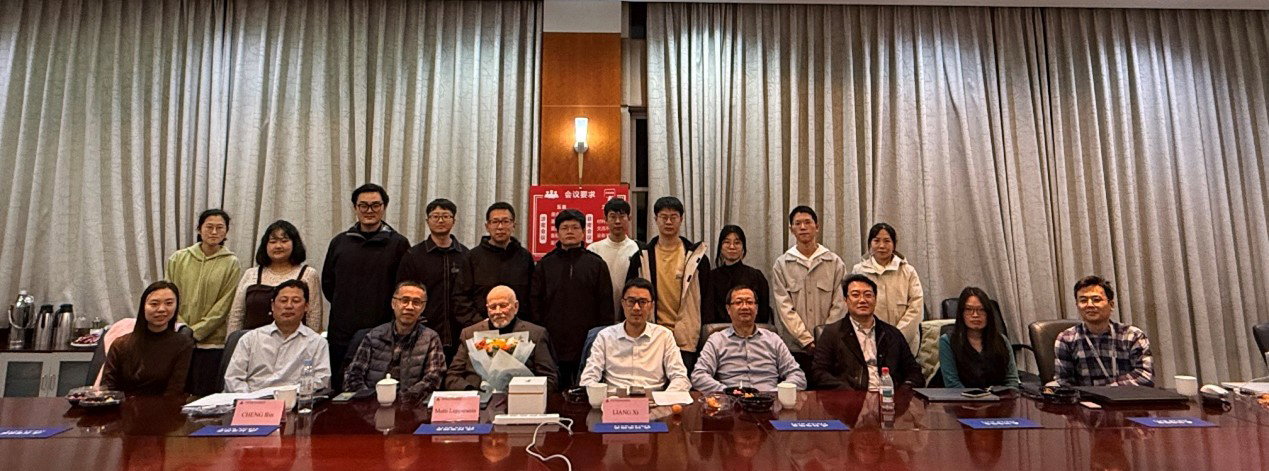
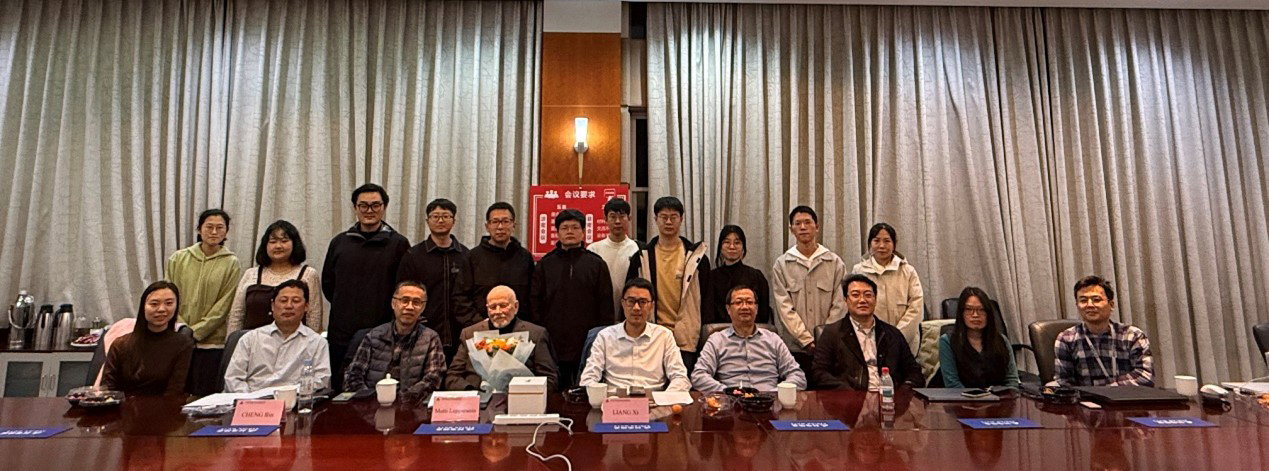
On November 2, 2025, the Digital Environment Research Laboratory of the International Research Center of Big Data for Sustainable Development Goals (CBAS) hosted the Symposium on Polar and Cold-Region Cryosphere and Climate Change at the Aerospace Information Research Institute, Chinese Academy of Sciences (AIR-CAS). More than 20 experts and scholars from China, Finland, and Germany participated in the symposium through a hybrid format combining in-person and online attendance. Participants included Professor Matti Leppäranta, Honorary Professor at the University of Helsinki and a recipient of the Chinese Academy of Sciences International Talent Program; Professor Bin Cheng of the Finnish Meteorological Institute (FMI); Professor Yubao Qiu of CBAS; Professor Qun Li of the Polar Research Institute of China (PRIC); and Professor Xi Liang of the National Marine Environmental Forecasting Center (NMEFC), among others.
Professor Matti Leppäranta has been a key initiator and driving force behind China–Finland collaborative research on the cryosphere. His long-standing research on the physical processes of sea ice, lake ice, snow, and ice has made outstanding contributions to establishing a long-term, stable, and productive framework for bilateral cooperation. Coinciding with the 75th anniversary of diplomatic relations between China and Finland and the International Year of Glaciers' Preservation, the symposium built on this established partnership to further strengthen academic exchange and mutual understanding. It aimed to foster an international collaborative network for research on polar and cold-region cryospheric processes, with in-depth discussions focusing on sea ice, snow, remote sensing observations of lake ice, and the impacts of climate change. The meeting also provided an opportunity to examine key scientific questions and future challenges in these fields.
At the opening of the symposium, Zhang Zhanhai, former Chief Engineer of the Ministry of Natural Resources of the People's Republic of China, delivered an address. He reviewed the history and major achievements of China–Finland cooperation in cryosphere science, spoke highly of Professor Leppäranta's pivotal role in fostering bilateral collaboration, and wished the symposium every success.
The symposium featured 16 thematic presentations, with speakers representing the International Research Center of Big Data for Sustainable Development Goals (CBAS), the Aerospace Information Research Institute of the Chinese Academy of Sciences (AIR-CAS), the University of Helsinki (UH), the Finnish Meteorological Institute (FMI), Dalian University of Technology (DUT), the National Marine Environmental Forecasting Center (NMEFC), the Polar Research Institute of China (PRIC), Harbin Engineering University (HEU), Ocean University of China (OUC), the University of Oulu (OU), the Alfred Wegener Institute (AWI), and other institutions.
The presentations covered a wide range of cutting-edge topics, including the climatic sensitivity of seasonal lake-ice characteristics; artificial intelligence-based reconstruction of Antarctic sea-ice thickness; changes in the thermal conductivity of landfast ice of different ages; variations in snow density and their effects on the sea-ice heat balance; assessments of vessel navigability in dynamically compressed ice zones; the development of cryospheric observation and forecasting networks; simulations of energy and mass budgets in polar snow and ice; and analyses of Arctic sea-ice deformation and fracture potential. Participants engaged in in-depth discussions on observations of cryospheric processes in both the Arctic and Antarctic, data assimilation, model simulations, and the scientific implications of these processes in the context of climate change.
Following the 2023 HiMAC workshop on river, lake, and sea ice, this symposium marked another joint polar and cold-region research event organized by CBAS and AIR-CAS. It provided a valuable platform for advancing cryosphere research in China, strengthening international scientific collaboration, and promoting academic exchange among early-career researchers.